REVIVING – revisiting mine tailings to innovate metals biorecovery
Operation ID: 67
Acronym: REVIVING
Topic: 3. Processing, Production and Remanufacturing
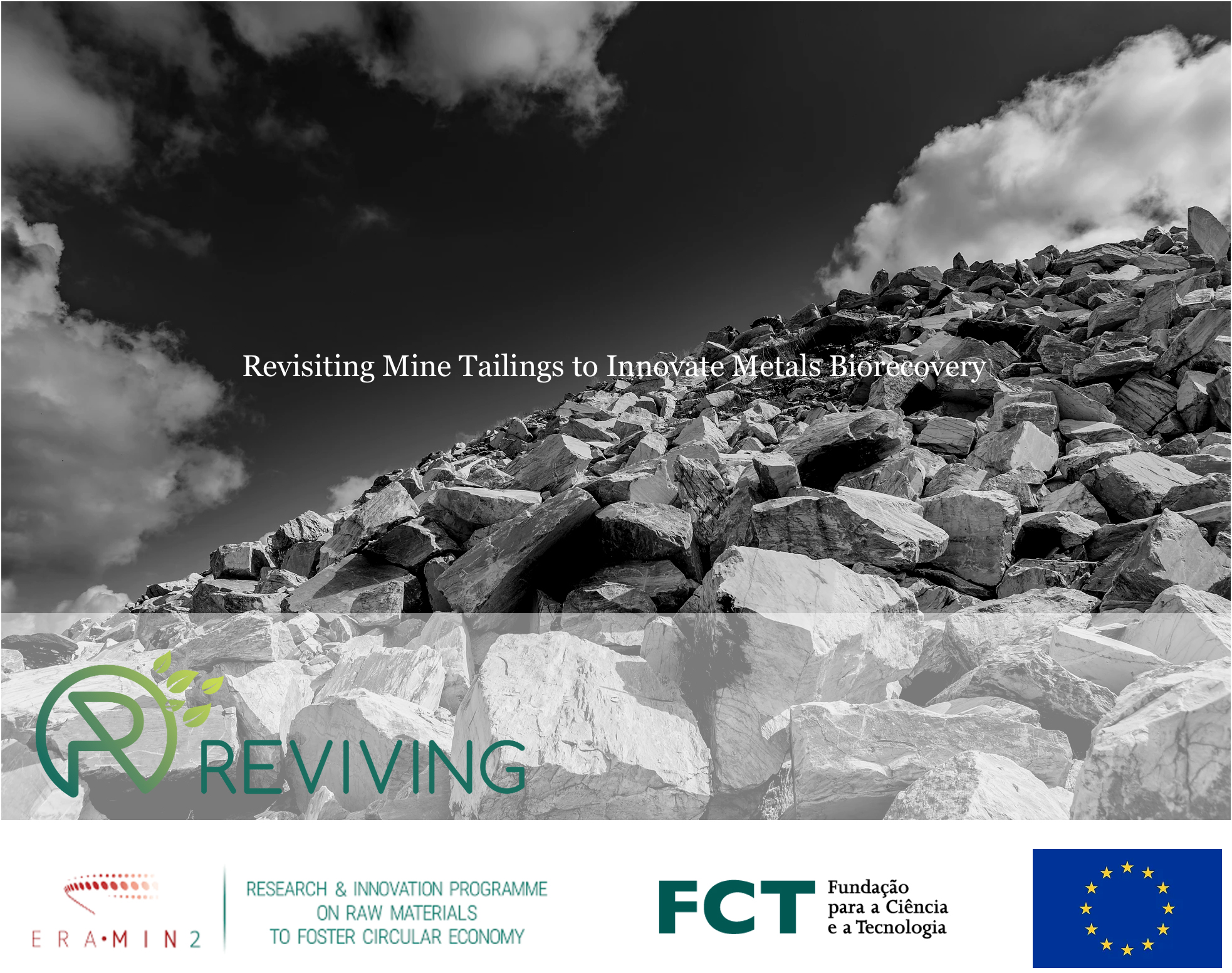
Title: REVIVING – revisiting mine tailings to innovate metals biorecovery
Scientific Area: Biohydrology and Circular Economy
Coordination: University of Coimbra
Financing Program: ERAMIN 2 – Research & Innovation Programme On Raw Materials To Foster Circular Economy
Financing Institution: FCT – Fundação para a Ciência e a Tecnologia
Project Duration: 36 Months ( 11 / 2021 to 10 / 2023 )
Total Investment: 347.329,50€
EU Investement: 224.119,80€
Projects Details
This project is focused on valuing mine tailings as resources, supplying metals that are extracted today via other processes, promoting recycling, minimizing the production of hazardous waste and thereby embracing a circular economy. The project uses knowledge obtained in the ERAMIN project BioCriticalMetals(ERAMIN/0002/2015) on the microbiome of tailings. The objective of the REVIVING project is to get improved models for efficiently recycling metals from residues in case-study mines. For the first time, this is based on autochthonous tailings microbiome manipulation to promote the bioleaching-bacterial populations and innovative hydrometallurgy.
The project covers the entire cycle of obtaining metals, from secondary sources to a product to sell. At the same time, by enabling true tailings recycling and reduction of residues produced by mining, we reconnect raw materials to the society. In perspective, the tailings basins could be used as a productive system for the provision of marketable metals. The expected success of this work will result in the validation of a clean, economic and innovative bioprocess for metal recovery from wastes, which will return residues to the productive cycle, supporting the EU’s transition to a circular economy.
The project will consist of several work steps, starting with small-scale assays performed in columns to test the potential of the manipulation of the tailings microbiome in leaching of Cu, Mn, Zn, Mo (non-critical major elements), W and Mg (critical metals) from tailings from Portuguese (Beralt Tin & Wolfram, Panasqueira) and Romanian (CUPRUMIN S.A. Abrud, CNCAF Minvest Deva) mines. REVIVING will innovate the bioleaching process enabling zero mine waste. The generated knowledge will push the EU to the front of the raw materials processing technologies and solutions. By recycling mine residues, soil areas will be returned to agriculture, forestry, and population, increasing mine social acceptance.
Consórcio
Newsletters
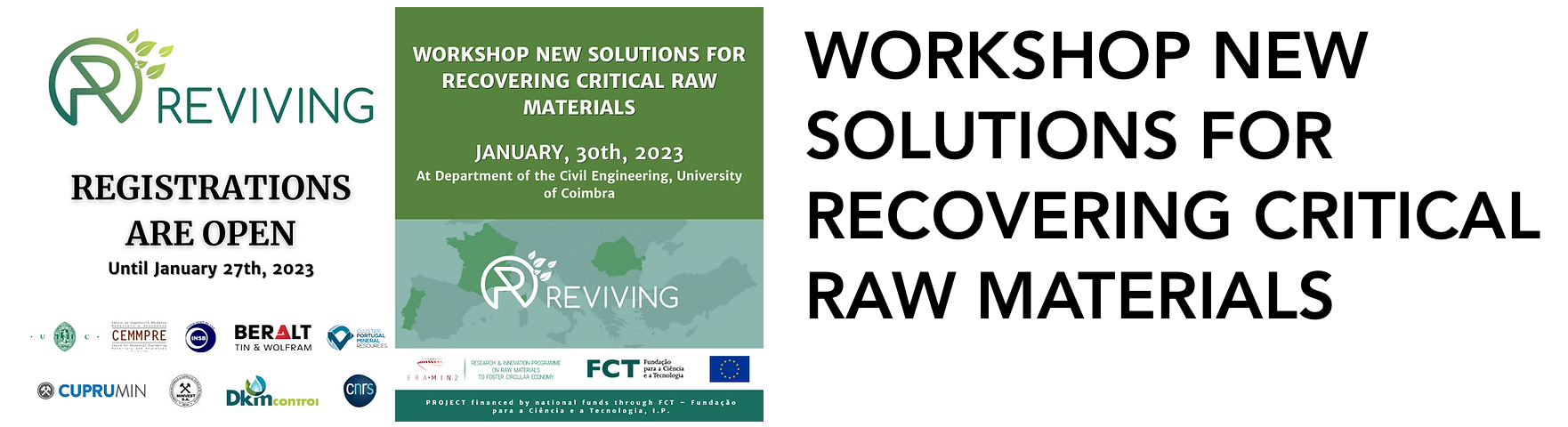
The REVIVING Project – revisiting mine tailings to innovate metals bio-recovery is inviting you to attend the workshop New Solutions for Recovering Critical Raw Materials.
The workshop will be held in English at the Department of Civil Engineering, University of Coimbra, and online, on January 30th. Focusing on the thematic of using mining wastes as a source of raw materials and new solutions for recovering raw materials.
The ERAMIN REVIVING project was represented at the SUMEX Clustering Workshop: “Uptaking sustainability: from research to reality”, by the project coordinator, Prof. Paula Morais, on June 15th 2021, online. The focus of the presentation was the exposition of the project and its main objectives, with special emphasis to the description of how Reviving can contribute to the reduction of environmental and social impacts.
SUMEX is a project funded by the European Commission that started on 1 November 2020. The project aims to establish a sustainability framework for the extractive industry in Europe, with the involvement of stakeholders from civil society, academia, industry and government backgrounds from all across the EU.